Next week IHR Advisors travels to Copenhagen for the International Bar Association Annual Conference, which runs at the Bella Centre from 4 to 9 October 2026. Ben Keith is speaking on three panels on Wednesday 7 and Thursday 8 October, and Cristian González Ruiz will be there all week to meet practitioners working on INTERPOL, extradition and sanctions matters from around the world.
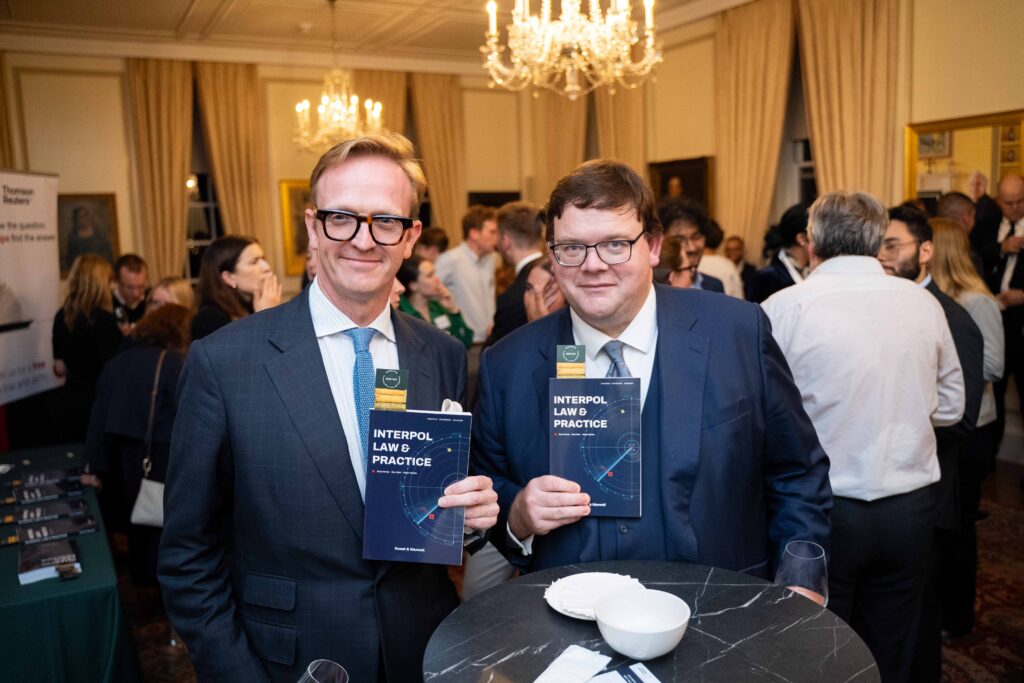
It has been a busy fortnight. On 23 September we launched INTERPOL Law and Practice (Thomson Reuters, 2026) at the Inner Temple in London. More than 100 guests came, among them extradition barristers and solicitors, journalists, immigration practitioners, academics and the NGOs that track transnational repression. The book brings the INTERPOL Constitution, the Rules on the Processing of Data, the CCF Statute and the national extradition case law into one practitioner’s text. It grew out of the same casework that is taking us to Denmark. Thank you to everyone who came.
Ben’s three sessions in Copenhagen each deal with a version of the same problem. Lawyers are now targets.
The first, on Wednesday 7 October at 11.15 in Room B5 6, is convened by the IBA’s Human Rights Institute and chaired by Hina Jilani: Law as shield and sword: targeted sanctions and the contest over legal tools for accountability. Targeted sanctions freeze the assets and restrict the travel of named individuals, and they have become one of the main tools for holding human rights abusers to account. The same instrument can be turned around.
The second, at 14.30 the same day in Room B2 2+4, is the Immigration and Nationality Law Committee’s annual panel, chaired by Sandra Grossman, on the international law implications of third-country removals and legal strategies for challenging them. Third-country removal is the practice of a state sending an asylum seeker to a country other than the one they fled or the one that received their claim. The United Kingdom, the United States, Italy and Denmark itself have each tried a version of it. The panel sets out the standards under the 1951 Refugee Convention and Article 3 of the European Convention on Human Rights, and compares what has worked in court.
The third, on Thursday 8 October at 14.30 in Room B5 6, is chaired by Marissa Kardon Weber: From courtroom to community: strategic lawyering in restrictive environments. This one is about the people who bring the cases. A lawyer who contests a Red Notice or challenges a removal in a hostile state often carries the risk personally, through disbarment, surveillance, criminal proceedings or a Red Notice of their own. The session covers what those lawyers need and what the rest of the profession can do about it.
IHR Advisors acts for individuals facing politically motivated Red Notices, extradition requests, removals and sanctions designations, and for the lawyers and journalists who represent and report on them, through INTERPOL and the CCF, the international law mechanisms, including the European Court of Human Rights, and sanctions advisory.
Our thanks to the International Bar Association, the IBA Human Rights Institute and the Immigration and Nationality Law Committee for the invitations.
If you or a client face a sanctions designation, a third-country removal or a Red Notice, contact us in confidence.