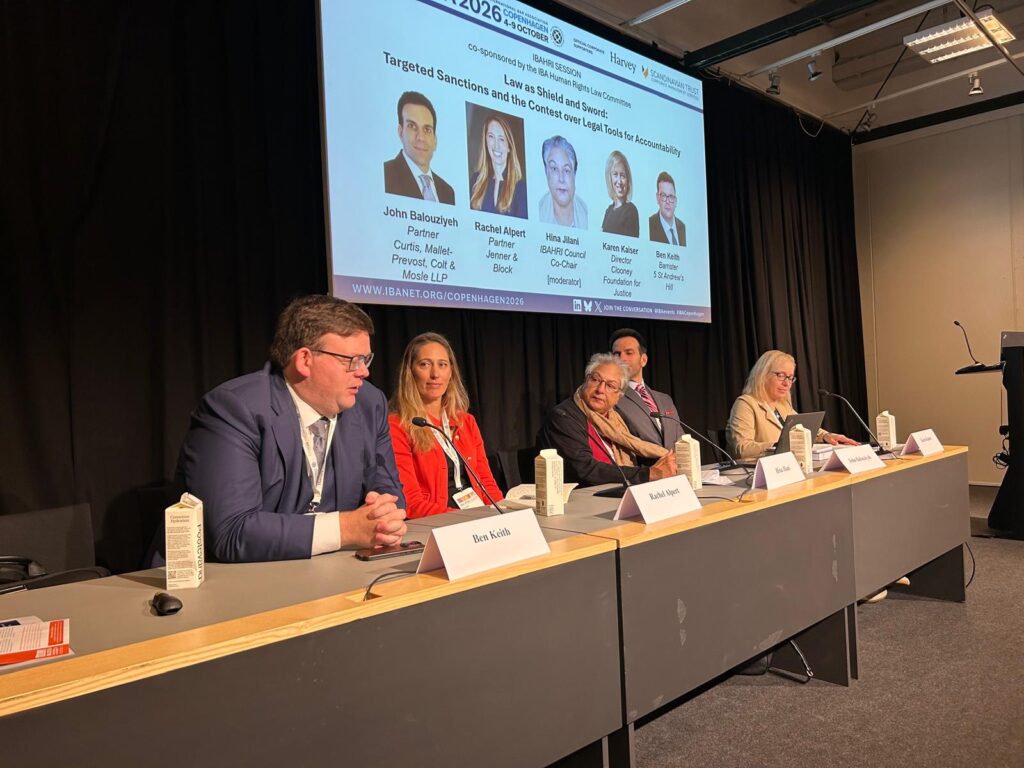
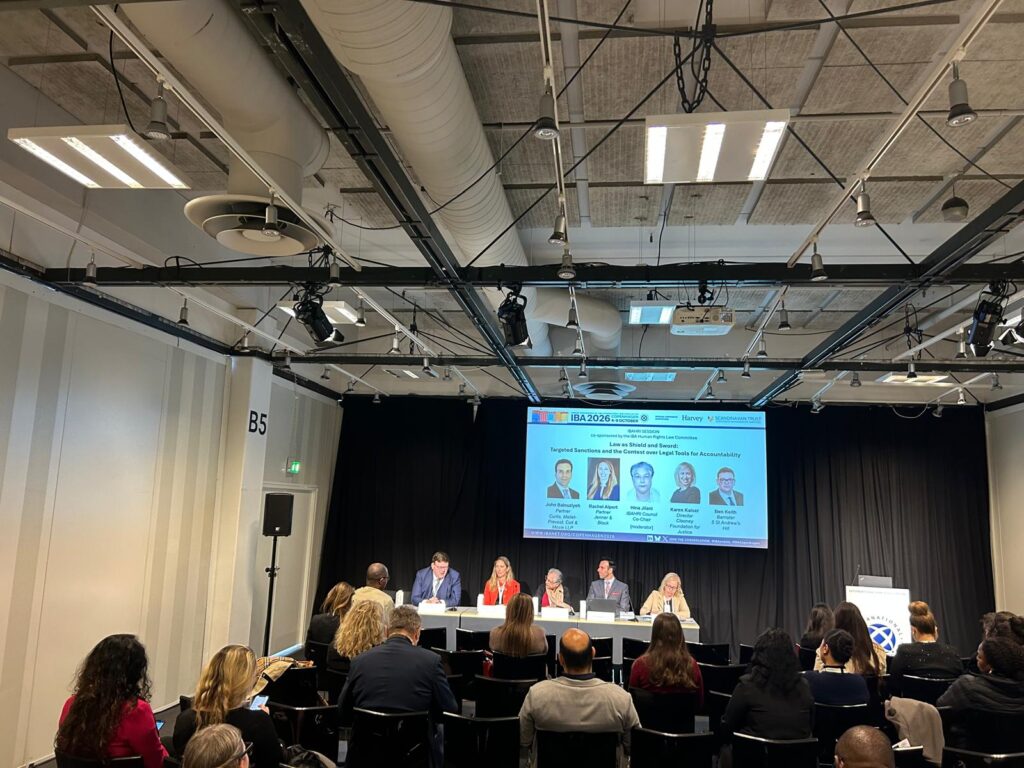
On 7 October 2026, Ben Keith spoke at the International Bar Association’s Annual Conference in Copenhagen on Law as shield and sword: targeted sanctions and the contest over legal tools for accountability. The session was led by the IBA’s Human Rights Institute and chaired by its Co-Chair, Hina Jilani. Ben drew on the organisation’s sanctions and INTERPOL practice to ask a practical question. When does a designation hold a wrongdoer to account, and when does it become something else?

The panel

  • Hina Jilani (Chair), Supreme Court of Pakistan; Co-Chair, IBA’s Human Rights Institute
  • Rachel Alpert, Jenner & Block, Washington DC; former Chief Counsel at the US Treasury’s Office of Foreign Assets Control
  • John Balouziyeh, Curtis, Mallet-Prevost, Colt & Mosle LLP; Co-Vice Chair, IBA Human Rights Law Committee
  • Karen Kaiser, Clooney Foundation for Justice; Chair, IBA Media Law Committee; former General Counsel of the Associated Press
  • Ben Keith, 5 St Andrew’s Hill; co-founder of IHR Advisors

How did targeted sanctions develop?

Targeted sanctions are asset freezes, travel bans and financial restrictions aimed at named individuals or entities rather than at a whole country. Hina Jilani opened with their legal root in Article 41 of the UN Charter. She also recalled Kofi Annan’s 1997 warning about the harm that countrywide sanctions inflict on civilian populations.

Rachel Alpert traced how sanctions moved from territory to individuals. During the Cold War the UN imposed sanctions only on Southern Rhodesia and South Africa. Security Council Resolution 1267 in 1999 created the first list of named individuals, aimed at the Taliban. Activity-based programmes followed after September 11, covering terrorism, cartels and, later, human rights abuse and corruption. She noted that the US Global Magnitsky programme refers to “serious human rights abuse” and not to the international law standard. That drafting choice, she said, has made designations possible that sit uneasily with international law. Her examples were the 2025 designation of Brazilian Supreme Court Justice Alexandre de Moraes and the sanctions regime aimed at the International Criminal Court.

John Balouziyeh described the opposite extreme. Syria was designated a State Sponsor of Terrorism in 1979 and stayed on the list until its recent removal. The designation stripped Syria of sovereign immunity in US courts. The resulting default judgments are counted in tens of billions of dollars. On his estimate, the claims still pending could take the total to between $700 and $800 billion, against a Syrian economy of around $21 billion a year.

Karen Kaiser turned to journalists. She described how governments now use tax and fraud charges against reporters, giving the cases of Maria Ressa and Jimmy Lai. She also described strategic lawsuits, such as the dozens of defamation claims Daphne Caruana Galizia was fighting when she was killed. She listed Red Notices among the tools of transnational repression. And she made the case, following the High Level Panel of Legal Experts on Media Freedom, for Magnitsky-style sanctions against those who attack the press.

What did Ben Keith argue about Magnitsky sanctions?

Magnitsky sanctions are designations aimed at individuals responsible for gross human rights abuse or serious corruption. Bill Browder campaigned for them after the death of his employee Sergei Magnitsky in Russian custody in 2009. Ben has worked alongside Browder, and he gave the regimes credit for reaching the statute books in the United States, the United Kingdom, the European Union and Canada.

His concern was with how they are used. Sanctions, he said, are only as good as the people applying them, and too often they are a ‘lazy part of foreign policy’. They are imposed without thought for the consequences. The lists catch the obvious targets, such as terrorist leaders and drug traffickers, and few others. Heads of state and senior politicians are rarely listed. The individual named is badly hurt, and the regime behind them is barely touched.

He set two cases side by side. Sanctioning a Brazilian Supreme Court justice meant one government attacking another state’s sovereign judiciary. The designations of Georgian judges, prosecutors and security officials rested on much stronger evidence of corruption and election interference. Even so, Ben argued, they have achieved little and may have backfired. They gave the Georgian Dream government a story of Western interference, which it has used to justify its turn towards Moscow. And where sanctions follow personal grievance, as with the current US measures against the ICC, they become ‘revenge rather than an agent for change’.

What do INTERPOL Red Notices teach about sanctions?

Ben’s second point drew on the organisation’s INTERPOL work. A Red Notice is one of the fastest instruments in international law. A notice issued now can lead to an arrest at an airport within the hour, followed by custody, extradition proceedings or expulsion. Refugees face particular danger. INTERPOL cooperates with every member state whatever its record, and the heaviest abusers, among them Russia and Turkey, carry on with very little comeback. Ben put that down to a lack of funding and a lack of will.

The parallel is clear. A sanctions designation and a Red Notice both put a name on a list. Both do most of their damage before any court has looked at the case. And both depend on the good faith of the state doing the listing. In our view, a list is only as fair as the route off it.

What came up in questions?

Asked how Taliban leaders could be held to account for gender persecution if the Security Council will not act, Ben recommended coordinated Magnitsky-style sanctions from the European Union, the United Kingdom, Canada and the United States, tied to the ICC’s arrest warrants. He was candid about the obstacle. European governments returning migrants to Afghanistan have to deal with the Taliban to do it. He also doubted that the ICC would survive in its present form, given the absence of the United States and China. Hina Jilani answered that civil society wants the Court’s flaws corrected rather than the Court abandoned.

Targeted sanctions can work. As Ben put it, they are currently used piecemeal, without any overarching idea of what they are meant to achieve.

How IHR Advisors can help

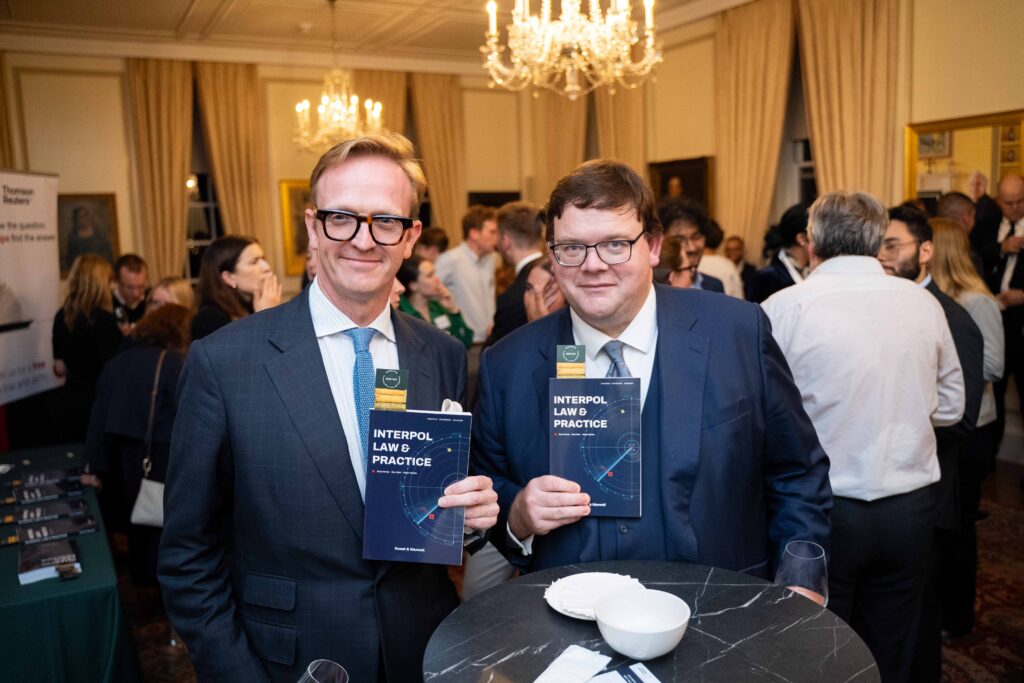
Our sanctions practice advises individuals and businesses on designations and delisting, and supports Magnitsky-style advocacy against those responsible for human rights abuse and corruption. Our INTERPOL practice acts for people facing politically motivated Red Notices and Diffusions, before the Commission for the Control of INTERPOL’s Files and in the extradition proceedings that follow an arrest. Ben Keith and Rhys Davies set out how to challenge notices in INTERPOL Law and Practice, published by Thomson Reuters on 23 September 2026.

Our thanks to the IBA’s Human Rights Institute, to Hina Jilani for chairing, and to Rachel Alpert, John Balouziyeh and Karen Kaiser. Details of the session are on the IBA website.

If you are affected by a sanctions designation or an INTERPOL notice, contact us in confidence.

About the Author

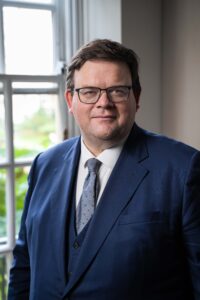
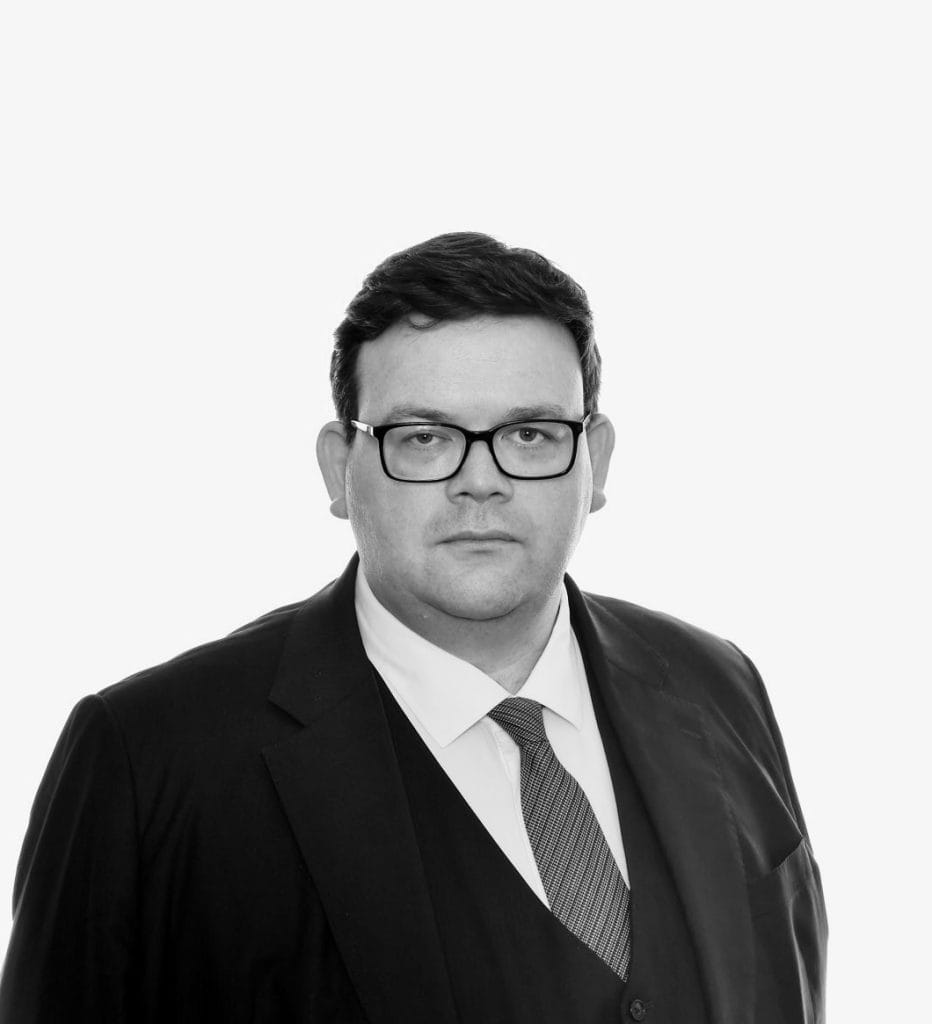
Ben Keith Barrister

Ben Keith is a co-founder of IHR Advisors and an internationally recognised lawyer specialising in INTERPOL Red Notice challenges, extradition, international human rights law and asylum. He is the co-author of Interpol, Law and Practice (Sweet & Maxwell, 2026). He is co-editor of Red Notice Monitor, the leading public resource on INTERPOL Red Notice abuse and the practice of INTERPOL’s Commission for the Control of Files.

Ben represents clients across every region in INTERPOL Red Notice and Diffusion challenges before the Commission for the Control of Files. He has secured the deletion of Notices issued by states including Russia, China, the United Arab Emirates, Turkey, Belarus, Iran and Venezuela, in cases involving journalists, opposition political figures, refugees, human rights defenders and business figures targeted in commercial and political disputes. He is the author of the INTERPOL chapter in The Practitioner’s Guide to Global Investigations (Global Investigations Review, 2026).

Ben has appeared as counsel before the European Court of Human Rights Grand Chamber, the UK Supreme Court, the African Commission on Human and Peoples’ Rights, the Inter-American Commission on Human Rights, the UN Working Group on Arbitrary Detention, and the UN Committee Against Torture. He is a member of the List of Counsel for the International Criminal Court and the Kosovo Specialist Chambers in The Hague.

He regularly acts for politically exposed persons, journalists, human rights defenders and high net worth individuals facing extradition, INTERPOL Notices and other instruments of transnational repression. He provides legal commentary to national and international media including the Guardian, The Times, the Financial Times, The Telegraph, the BBC, Sky News, CNN, CBS 60 Minutes, The Economist, Politico and Al Jazeera.

Ben is ranked Star Individual in Chambers and Partners and a leading individual in The Legal 500 for extradition. He practises from 5 St Andrew’s Hill in London.

View Ben Keith's profile