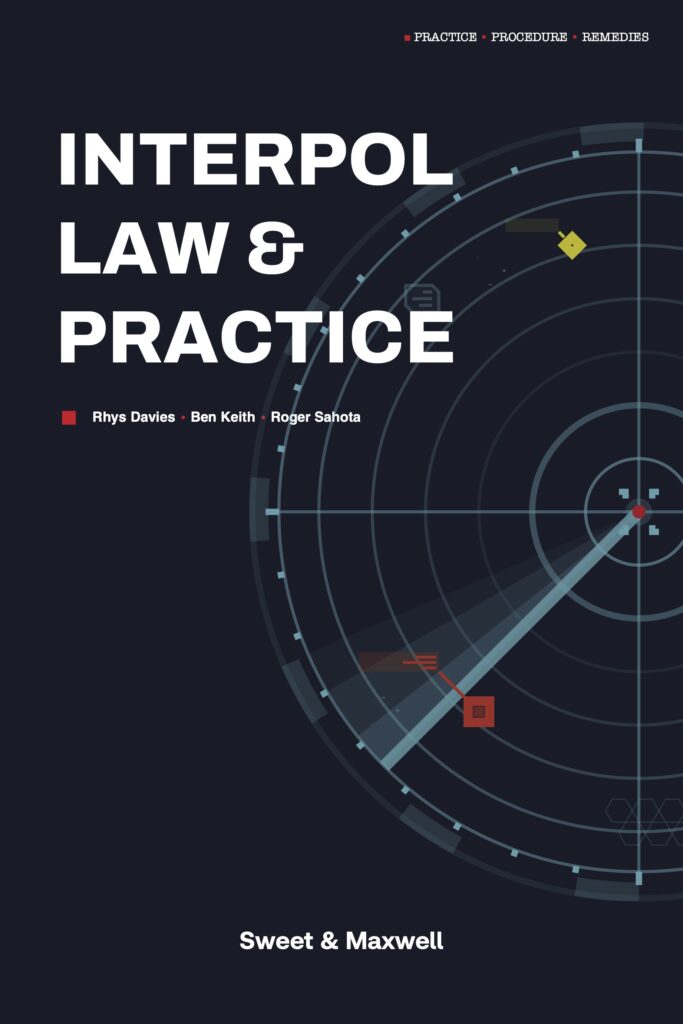
Interpol: Law and Practice
By
Ben Keith & Rhys Davies
Ben Keith and Rhys Davies have co-authored a brand new practical guide to INTERPOL, Red Notices and cross-border enforcement.
Interpol: Law and Practice is a new Sweet & Maxwell practitioner text on INTERPOL’s legal framework, its Notice and Diffusion system, and litigation before the Commission for the Control of INTERPOL’s Files (CCF). It will be published on 30 September 2026. It is written for lawyers who challenge INTERPOL Red Notices before the CCF, and for the agencies and governments that use the system legitimately.
INTERPOL Law and Practice gives you the roadmap to the inner workings of INTERPOL proceedings, so you can assess risk quickly and advise clients confidently. It gives practitioners the practical support they need to handle Red Notices, extradition, immigration, asylum, and related proceedings efficiently, with a stronger grasp of procedure, strategy, and the international context.
- Gain practical direction on Red Notices so you can protect your client’s position
- Draft winning CCF applications with step-by-step templates and real-world examples
- Strengthen your case strategy with analysis of arguments commonly raised before the CCF
- Advise more effectively on INTERPOL-related extradition, immigration, and asylum issues
- Never get caught off guard by the complexities of international law
- Checklists, Key Points and Tables make the information easily accessible
- Save research time with key legal instruments, cases, and references
What is in the book
Part I: INTERPOL and the Notice System
- Chapter 1, Introduction. What INTERPOL is and is not, from the 1923 Vienna commission to 196 member countries and 22 million database searches a day, and why its neutrality rule is under strain.
- Chapter 2, INTERPOL’s Organisation and Funding. The organs of the institution, who holds which competence, and where the money comes from, including the suspended €20 million FIFA agreement.
- Chapter 3, Notices, Diffusions and INTERPOL Databases. Every colour of Notice from Red to the new Silver, the Stolen and Lost Travel Documents database, and Diffusions, which bite just as hard.
Part II: Substantive Law Before the CCF
- Chapter 4, CCF Applications: A Practical Guide. The questions clients ask (is there a Notice, can I travel, how long will it take) and the mechanics of applying, with model documents.
- Chapter 5, Substantive Arguments Before the CCF. The three grounds for deletion: Article 3 and the predominance test, Article 2 human rights, and the Article 82 purpose test, with anonymised decisions.
- Chapter 6, Further Arguments and Notices Before the CCF. Offence-type challenges and how Blue, Green, Yellow and Purple Notices and Diffusions are contested.
Part III: CCF Practice and Procedure
- Chapter 7, Evidence in CCF Proceedings. What a documentary tribunal will and will not look at: witness and contextual statements, open-source material, court documents and expert reports.
- Chapter 8, CCF Procedure and Decision Outcomes. The timetable from admissibility to decision, the presumption of accuracy, the rule of non-enquiry, the range of outcomes and the revision procedure.
- Chapter 9, Litigation Before the CCF: Challenges and Risk Assessment. First steps on instruction, travel risk, a country-by-country table of how Red Notices are treated at the border, and recurring case types from corporate raiding to unfunded cheques.
Part IV: The Broader Legal Landscape
- Chapter 10, Extradition. Dual criminality, the political offence exception, Khodorkovsky, immunities, and what an extradition refusal does to a Notice.
- Chapter 11, Immigration, Asylum, and Related Matters. Red Notices in asylum claims, visa applications and United States removal proceedings, and the position of stateless individuals.
- Chapter 12, Conclusions. The pattern of abuse, the CCF’s limits, new leadership at INTERPOL, and the authors’ case for reform.
Appendix A reproduces extracts from the INTERPOL Constitution, the Rules on the Processing of Data and the Statute of the CCF.
Read more from the book
About the authors
Ben Keith is a barrister at 5 St Andrew’s Hill and co-founder of IHR Advisors, specialising in INTERPOL Red Notice challenges, extradition, sanctions and asylum. Chambers and Partners ranks him as a star leader in extradition and Legal 500 places him in Tier 1. Rhys Davies is a barrister at Temple Garden Chambers, called in 2004, and co-founder of IHR Advisors, practising in international criminal law, INTERPOL, extradition and business and human rights. Both co-edit the Red Notice Monitor blog. IHR Advisors associate Cristian González Ruiz was lead researcher on the book.
Interpol: Law and Practice can be pre-ordered from Sweet & Maxwell. For a confidential discussion of an INTERPOL matter, contact us.