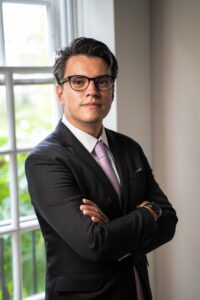
Cristian González Ruiz, associate at IHR Advisors, took part as an invited expert in the doctoral collegium of the Universidad Nacional de Mar del Plata in Argentina in July 2026. The session was held online with doctoral researchers working across international criminal law and public international law. Discussion ran from the definition of genocide through to what states are actually required to do when the crime is being committed somewhere other than their own territory.
Genocide and what the Convention requires of states
The 1948 Convention on the Prevention and Punishment of the Crime of Genocide does two things at once: it defines a crime committed by individuals, and it places binding obligations on states to prevent that crime and to punish it. Those two halves are often read apart. They should be read together.
The International Court of Justice settled the point in Bosnia and Herzegovina v Serbia and Montenegro on 26 February 2007, holding that the duty to prevent is an obligation of conduct rather than result, and that it bites once a state learns of a serious risk. A state need not control events on the ground before the duty attaches. It needs capacity to influence them. Later proceedings, The Gambia v Myanmar and South Africa v Israel, have tested how far any state party can litigate that duty against another, since obligations under the Convention are owed erga omnes partes and standing does not depend on injury.
Genocide is distinguished from every other core international crime by its mental element: the perpetrator must act with intent to destroy a national, ethnical, racial or religious group, in whole or in part. That is dolus specialis, and proving it is where most genocide cases live or die.
The collegium also looked at what happens when international fora stall and domestic courts step in. Universal jurisdiction has moved a good deal of this work into national systems, and Latin American practice is part of that record: Argentine courts framed the repression of the 1976 to 1983 dictatorship in genocidal terms in the 2006 Etchecolatz conviction, and Argentine judges have run investigations into crimes committed in Spain and in Myanmar. The jurisdictional theory is not the obstacle people expect. Evidence, witness protection and political appetite usually are.
We advise governments and individuals on international criminal law. Cristian previously worked at the International Criminal Court on war crimes and crimes against humanity proceedings, and practises in Spanish, English and French from The Hague. Our international law practice covers accountability work from first evidence review through to submissions.
Our thanks to the Facultad de Derecho of the Universidad Nacional de Mar del Plata for the invitation, and to the doctoral researchers who brought the questions.