Human rights lawyers and Hong Kong campaign groups say Red Notices have become part of Beijing’s campaign to silence critics, and call on governments to act at next week’s Interpol General Assembly.
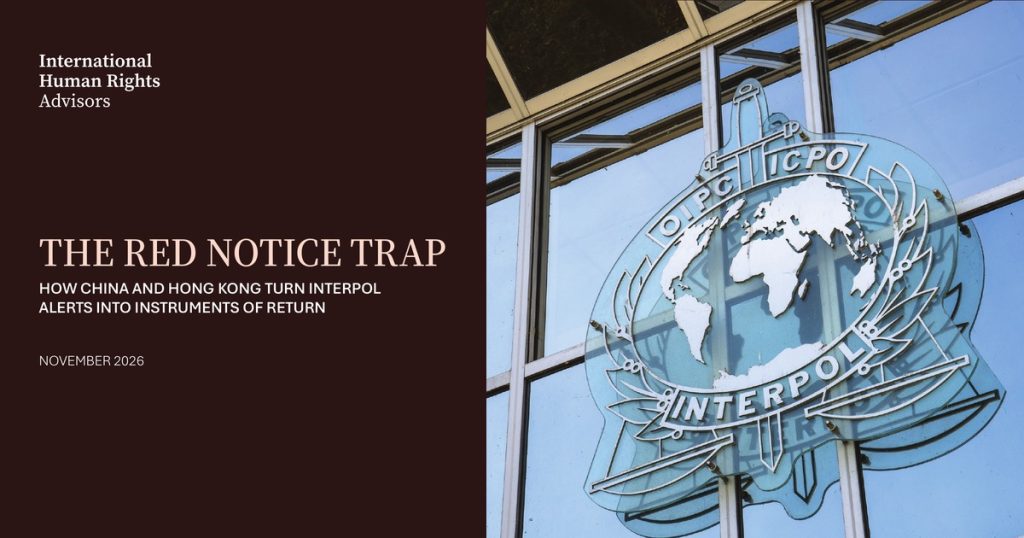
LONDON, 25 NOVEMBER: China has abused Interpol’s Red Notice system, and Hong Kong now uses the same channel, according to a report published today by International Human Rights Advisors (IHR Advisors) with Hong Kong Watch and the Committee for Freedom in Hong Kong Foundation. Released ahead of Interpol’s 94th General Assembly, it sets out the reforms the three organisations want governments to demand when the world’s police chiefs meet in Hong Kong from 30 November to 3 December.
The Red Notice Trap: How China and Hong Kong Turn Interpol Alerts into Instruments of Return, by barristers Ben Keith and Rhys Davies of IHR Advisors, draws on court judgments, Interpol records and Chinese-language official documents. It uses them to show how Red Notices fit into Beijing’s campaign to silence Chinese Communist Party critics and bring them home for persecution.
Ben Keith, co-founder of IHR Advisors, said: “Next week the world’s police chiefs will be the guests of a state that uses Interpol to hunt its opponents. That is absurd. Hong Kong is using the Assembly to buy legitimacy and to distract from China’s endless list of abuses at home and overreach abroad, from the jailing of Jimmy Lai and Joshua Wong to the alleged spy operation targeting Nvidia’s Jensen Huang. As this report uncovers, that list includes the well-documented abuse of Interpol itself.”
“No government has learned to finesse the system more skilfully than China’s, and Hong Kong now uses the same channel. Interpol’s own constitution forbids it from touching political cases but time and again we see the CCP ruthlessly abusing Interpol to haul back innocent people championing civil liberties.
“Governments that take the rule of law seriously must use this Assembly to draw attention to these abuses and demand reform from within Interpol.”
China’s own figures show how little of their repatriation campaign runs through the courts. By the authorities’ count, Operation Sky Net returned 14,048 people from more than 120 countries in its first decade, and only 79 were extradited. Official accounts describe “persuasion to return” as freezing assets, working through relatives and narrowing the space in which a person can live abroad.
In one case the report sets out, a senior Hong Kong national security official discussed cancelling a Red Notice if its target came back. The target was a businessman detained in France in 2021. A French court refused extradition, and Interpol later deleted his data.
Hong Kong is not a member of Interpol in its own right, and its requests pass through China’s National Central Bureau in Beijing. Since 2023 the Hong Kong authorities have issued warrants and bounties against activists abroad, and relatives in Hong Kong have been questioned. The report notes there is no public evidence that any of those wanted yet faces a Red Notice.
Rhys Davies, co-founder of IHR Advisors, said: “Almost 170,000 Hong Kongers have made new lives in Britain since 2021. They came here to be free of the Hong Kong authorities, yet too many have found those authorities following them, with bounties on activists’ heads and families questioned back home. Britain must make sure Interpol cannot be turned against the people it promised to protect.”
Interpol’s safeguards can work, but slowly. Idris Hasan, a Uyghur activist, was arrested in Casablanca in July 2021 on a Chinese notice that Interpol cancelled within two weeks. Moroccan extradition proceedings carried on regardless, and he spent 43 months in custody.
Megan Khoo, Policy and Advocacy Director of Hong Kong Watch said: “Jimmy Lai is serving 20 years. Joshua Wong was months from freedom when he was handed 10 more years. This is the Hong Kong that is now hosting the world’s police chiefs. A government that jails its critics at home and puts bounties on them abroad should not be trusted with the tools to hunt them across borders.”
The three organisations are calling for three things before the Assembly opens:
- governments agree a slate of demonstrably independent candidates for the Commission for the Control of Interpol’s Files, the body that can order abusive notices deleted, all seven of whose members will be elected in Hong Kong
- Interpol publishes figures by country on requests, refusals and deletions, with Hong Kong shown separately
- a public assurance that scrutiny and civil-society access at the Assembly will not be restricted
They also want Interpol to create a rapid interim mechanism for cases where a credible Article 2 or 3 issue arises and the person is detained or about to be. Article 2 covers human rights, and Article 3 bans political cases. Under the mechanism, a notice could be temporarily blocked or flagged while the constitutional question is examined. At present a challenge can take months: in 2024 only 30 per cent of requests for access to Interpol’s files were answered within the four-month target. As Hasan’s case shows, a notice cancelled after an arrest may come too late to stop what national authorities have already set in motion.
At home, they say governments should make clear in law that a Red Notice is neither a finding of guilt nor an extradition order. Any arrest, detention or travel restriction triggered by Interpol data should need an identifiable legal basis in domestic law. Governments should also make
sure Interpol’s deletion decisions actually reach their police, border and immigration officers. Interpol already notifies member states, but the report finds the failure usually lies in passing that information on at home.
Alan Dai, public affairs and advocacy manager at the Committee for Freedom in Hong Kong Foundation, said: “Beijing is not just policing Hong Kong. It is policing people in the United Kingdom, United States, and Canada: watching them, threatening their families and trying to get them home. That is happening on our soil, under our laws. Western governments cannot keep treating transnational repression as someone else’s problem. A bully keeps pushing until someone pushes back, and Hong Kong is the place to start.”
The report stresses that not every notice from China or Hong Kong is abusive, and that no rate of abuse can be calculated from the data Interpol publishes.
ENDS
Notes to editors
- This release is issued jointly by International Human Rights Advisors, Hong Kong Watch and the Committee for Freedom in Hong Kong Foundation.
- The Red Notice Trap: How China and Hong Kong Turn INTERPOL Alerts into Instruments of Return is available here.
- Ben Keith is a barrister at 5 St Andrew’s Hill, and Rhys Davies is a barrister at Temple Garden Chambers. Both specialise in human rights and international law and represent people challenging Red Notices. They run International Human Rights Advisors LLP.
- Hong Kong Watch is a UK registered charity founded in 2017, consisting of Hong Kongers and friends of Hong Kong, working closely with Hong Kong community groups in the diaspora.
- Founded in 2022, the Committee for Freedom in Hong Kong (CFHK) Foundation is a U.S.-registered charity that aims to free all of Hong Kong’s political prisoners.
- Media contacts: Oliver Aplin, Aplin Communications, oaplincomms@gmail.com, +447851552441