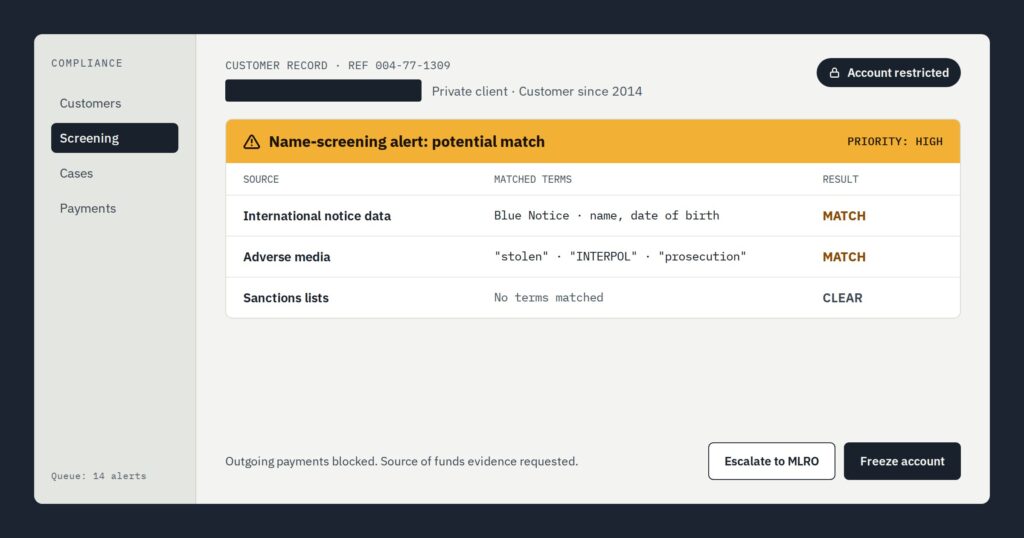
INTERPOL maintains a register of travel documents which member states have reported stolen, lost, revoked or otherwise invalid, known as the Stolen and Lost Travel Documents database, or SLTD. It is queried constantly, by border officers and by airline check-in systems. Only the issuing state may make an entry, but an entry takes effect the moment it is made, without notice to the holder of the document, without any review of the decision to make it, and with no way of objecting in advance.

The database was built to catch people travelling on other people’s passports, and for that purpose it works well enough. The difficulty arises where the issuing state is the state a person has left. Cancelling his passport then becomes a means of getting him back, and it operates in airports and border control points rather than in courtrooms. It is an area of our INTERPOL practice that rarely reaches the headlines.

What happens when a cancelled passport is flagged at check-in

A client of ours discovered this at an airport in the Balkans. A Turkish national, he had lived in the United Kingdom for years on a business visa, together with his family. Turkey says all of them are Gülenists, associated with the movement the Turkish government has pursued since the attempted coup of 2016 and treats as a terrorist organisation. Turkey cancelled his passport on that basis and reported the cancellation to INTERPOL. He learned of it only when he handed the passport across a check-in desk and was taken to one side.

What happens after that is regulated by rules of carriage rather than by any court. An airline presented with an invalid travel document will ordinarily return the passenger to his state of nationality. Here that meant a flight to Istanbul, and it meant that a man against whom Turkey had made no extradition request would arrive in Turkish custody without a hearing having taken place anywhere. Extradition proceedings exist precisely to decide whether a person should be sent to a particular state and what is likely to happen to him when he arrives there. The SLTD route reaches the same destination without either question being asked.

He sat in the airport for nine hours while we argued with the airline by telephone, making the same narrow point repeatedly: he had boarded in the United Kingdom, where he was lawfully resident, so the country of return ought to be the country the journey began in rather than the country which had cancelled the document. The airline accepted it and flew him to London.

Removing the SLTD entry

That dealt with the day itself but not with the entry, which remained live. While it remained live he could not travel at all.

We then challenged it, assembling the evidence of his residence and status in the United Kingdom and setting out the political background against which the passport had been cancelled. The case we put was that the entry was being used for a purpose the database does not exist to serve. It was removed, and the cancellation no longer follows him through INTERPOL’s systems.

Why the SLTD deserves more attention than it gets

Turkey is not the only government to have understood what a cancellation can do. The SLTD attracts a small fraction of the attention paid to Red Notices while reaching a great many more people. That is one reason Rhys Davies and Ben Keith deal with it at length in INTERPOL: Law and Practice (Sweet & Maxwell), published on 23 September 2026.

A Red Notice at least invites a challenge before the Commission for the Control of INTERPOL’s Files. A cancelled passport simply removes a person from the departure lounge.

How IHR Advisors can help

If your passport has been cancelled by a state you have left, we can advise on both halves of the problem: the airline at the desk, and the entry sitting behind it. We act on SLTD entries, Red Notices and Diffusions, and the wider questions of transnational repression and international law that so often sit behind them.

Contact IHR Advisors in confidence.

Contact details

If you would like to speak with us about our areas of practice or anything else please contact us via the form linked below.

Contact Us

About the Authors

Ben Keith Barrister and Co-Founder of IHR Advisors

Ben Keith is a co-founder of IHR Advisors and an internationally recognised lawyer specialising in INTERPOL Red Notice challenges, extradition, international human rights law and asylum. He is the co-author of Interpol, Law and Practice (Sweet & Maxwell, 2026). He is co-editor of Red Notice Monitor, the leading public resource on INTERPOL Red Notice abuse and the practice of INTERPOL’s Commission for the Control of Files.

Ben represents clients across every region in INTERPOL Red Notice and Diffusion challenges before the Commission for the Control of Files. He has secured the deletion of Notices issued by states including Russia, China, the United Arab Emirates, Turkey, Belarus, Iran and Venezuela, in cases involving journalists, opposition political figures, refugees, human rights defenders and business figures targeted in commercial and political disputes. He is the author of the INTERPOL chapter in The Practitioner’s Guide to Global Investigations (Global Investigations Review, 2026).

Ben has appeared as counsel before the European Court of Human Rights Grand Chamber, the UK Supreme Court, the African Commission on Human and Peoples’ Rights, the Inter-American Commission on Human Rights, the UN Working Group on Arbitrary Detention, and the UN Committee Against Torture. He is a member of the List of Counsel for the International Criminal Court and the Kosovo Specialist Chambers in The Hague.

He regularly acts for politically exposed persons, journalists, human rights defenders and high net worth individuals facing extradition, INTERPOL Notices and other instruments of transnational repression. He provides legal commentary to national and international media including the Guardian, The Times, the Financial Times, The Telegraph, the BBC, Sky News, CNN, CBS 60 Minutes, The Economist, Politico and Al Jazeera.

Ben is ranked Star Individual in Chambers and Partners and a leading individual in The Legal 500 for extradition. He practises from 5 St Andrew’s Hill in London.

View Ben Keith's profile
Rhys Davies Barrister

Rhys Davies is a co-founder of IHR Advisors and an internationally recognised lawyer specialising in INTERPOL Red Notice challenges, international criminal law and international human rights law. He is the co-author of Interpol, Law and Practice (Sweet & Maxwell, 2026). He is co-editor of Red Notice Monitor, the leading public resource on INTERPOL Red Notice abuse and the practice of INTERPOL’s Commission for the Control of Files.

Rhys co-authored the report Undue Influence: the UAE and INTERPOL with Sir David Calvert-Smith, examining the systemic misuse of INTERPOL’s Notice and Diffusion systems by the United Arab Emirates and the implications for INTERPOL’s governance. He represents clients in INTERPOL Red Notice challenges before the Commission for the Control of Files, with particular focus on cases involving Middle Eastern and Central Asian states, and on the position of refugees, journalists and political dissidents targeted through INTERPOL by their states of origin.

Rhys has significant experience of in-country legal advice and assistance, most recently in the West Bank, and a specific interest in the Middle East. He is a member of the List of Counsel for the International Criminal Court, the Kosovo Specialist Chambers, and the Special Tribunal for Lebanon. He regularly speaks at, and chairs, events at the United Nations Human Rights Council in Geneva and at the House of Commons on matters of international law.

Rhys is the author of numerous articles on INTERPOL Red Notice practice and on justice in the Middle East, and is in demand as a commentator on international human rights. He provides legal commentary to national and international media including The Times, the Guardian, the Independent, the Financial Times, CBS 60 Minutes, Sky News, City AM and Al Jazeera.

Rhys is recommended as a leading individual in The Legal 500. He practises from Temple Garden Chambers in London and The Hague.

View Rhys Davies's profile