Rhys Davies Speaks at Harvard Law School on Corporate Accountability in Conflict Zones
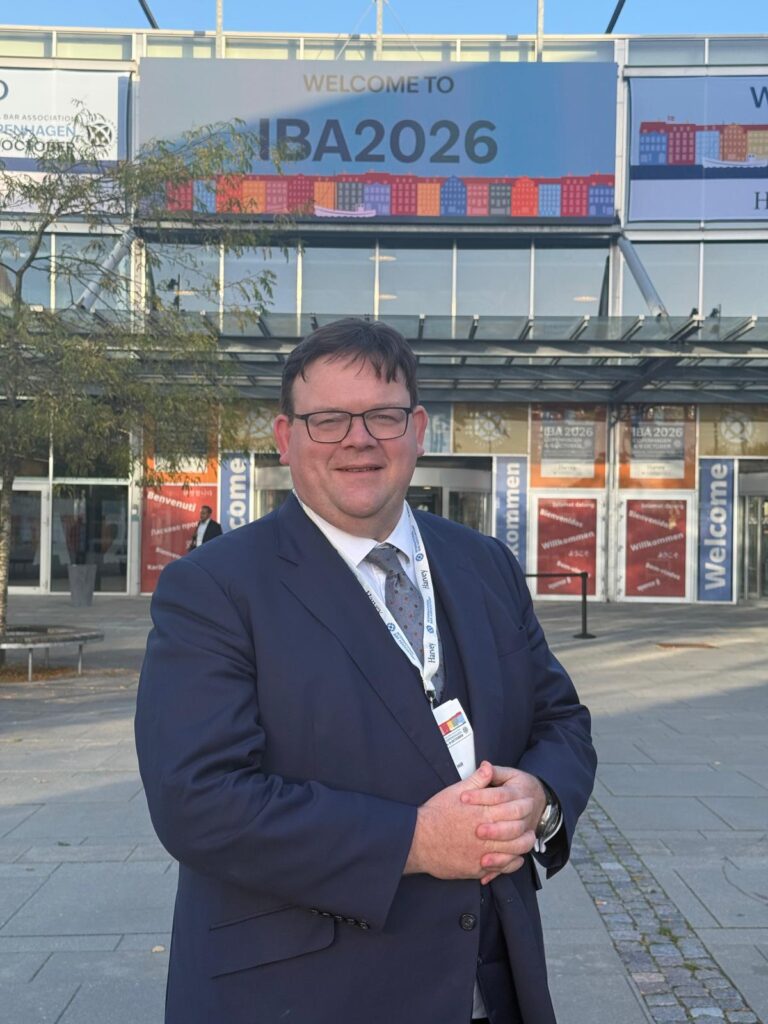
Rhys Davies, co-founder of IHR Advisors, took part in the panel “The Evolution of Conflict and the Private Actors: Navigating Corporate Responsibility on the Path to Peace” at the Harvard International Law Journal‘s Spring Symposium at Harvard Law School on 28 February 2026. The Symposium theme this year was “Resilient Order: International Law in an Age of Transition”.
He spoke alongside David Haeri, Director of the Policy, Evaluation and Training Division at the United Nations; Professor Tyler Giannini, Clinical Professor of Law at Harvard Law School and co-director of the International Human Rights Clinic; and Scott Gilmore of DiCello Levitt. The panel was moderated by Ana Isabel Fernández Alonso of Hausfeld in London.
The question put to the panel was a familiar one for anyone working in this area. Where corporate actors operate in conflict zones, and in some cases help finance or facilitate atrocities, can they actually be held to individual criminal account? Or does that ambition keep stalling at the level of soft-law commitments and civil claims?
Rhys answered from his international criminal law and cross-border enforcement practice. He started with the architecture. The body of rules covering conflict-related corporate conduct is wider than is sometimes assumed. Civil litigation, UN procurement and due diligence frameworks, sanctions, anti-corruption regimes and domestic criminal law all overlap. There is no shortage of rules. The shortfall is in enforcement. Civil claims yield damages and reputational consequences, but rarely criminal liability. UN procurement frameworks can exclude actors but cannot punish them. Domestic criminal law remains the most powerful tool, and the hardest to deploy, because conflict-zone evidence, jurisdiction and prosecutorial appetite rarely line up at the same time.

He then turned to the practical problem of running criminal proceedings across borders. Three institutions matter, and each has limits that practitioners run into quickly. INTERPOL is essential for locating suspects but operates a state-led notice system that is uneven in its treatment of corporate cases and increasingly open to political distortion. Universal jurisdiction is on the books in a growing number of states, but in practice it runs into political caution, resource constraints, and evidence thresholds that conflict-zone investigations rarely meet. The International Criminal Court is the institution most directly designed for accountability of this kind, but is currently operating in a climate in which withdrawals, non-cooperation, and sanctions targeting Court officials have narrowed its practical reach.
For clients, the question is increasingly the same one whichever side of a case they sit on. How do you defend against, acriminal case arising out of conduct in a conflict zone?
IHR Advisors works on both sides of that question. We advise governments and inter-governmental bodies on the design of accountability mechanisms. We act on cross-border criminal complaints, INTERPOL strategy and sanctions advocacy. We advise corporates on conflict-zone risk, internal investigations and the human-rights exposure that is now driving enforcement decisions. And we act for individuals facing extradition, INTERPOL Red Notices or universal-jurisdiction proceedings arising out of conflict-related allegations.
Our thanks to the Harvard International Law Journal for the invitation, to Ana Isabel Fernández Alonso for moderating, and to David Haeri, Tyler Giannini and Scott Gilmore for the depth of their contributions.
If you are working on, or affected by, accountability proceedings and International Police Cooperation, contact our team